Civil Society Strengthening for Effective Engagement in Holistic Human Development in Cameroon with Focus on Rural and Semi-Urban Communities Including Those Affected by Crisis

Civil Society Strengthening for Effective Engagement in Holistic Human Development in Cameroon with Focus on Rural and Semi-Urban Communities Including Those Affected by Crisis

Problem Analysis

The ongoing socio-political crisis in Cameroon’s North West and South West (NWSW) Regions has plunged millions of people into an atmosphere of insecurity, economic paralysis, and social fragmentation. Once-thriving communities have been reduced to survival mode, with thousands displaced and livelihoods destroyed. The conflict has eroded trust in governance systems, disrupted access to education and healthcare, and undermined the fabric of community life. Amid this instability, Civil Society Organisations (CSOs) have emerged as critical agents of hope—bridging humanitarian gaps, advocating for peace, and supporting vulnerable groups. Yet, despite their proximity to affected communities, most local CSOs remain structurally weak, under-resourced, and excluded from mainstream development funding.

Limited access to resources, inadequate institutional frameworks, and insufficient technical capacity have rendered many CSOs unable to effectively address the pressing needs of their communities. Their efforts, while passionate and community-driven, often lack sustainability due to weak management systems, poor documentation, and non-compliance with donor standards. Many struggle to align their proposals with funder priorities or to produce the kind of evidence-based reporting that sustains long-term partnerships. Consequently, the local response to the crisis in the NWSW regions has been fragmented—leaving gaps in essential services, protection for women and children, and inclusion of persons with disabilities.

It was within this context that LUKMEF-Cameroon conceived the “Civil Society Strengthening for Effective Engagement in Holistic Human Development in Cameroon” project. The initiative, supported by the Canadian High Commission in Cameroon through the Canadian Fund for Local Initiatives (CFLI), sought to transform this challenge into an opportunity for capacity reinforcement and collective action. Recognizing that sustainable change must be locally owned, the project aimed to equip CSOs in the NWSW regions with the operational and institutional competencies needed to deliver high-impact community interventions—even amidst crisis.

Through targeted training workshops, technical mentoring, and direct small grants, LUKMEF built a bridge between grassroots potential and donor confidence. Twelve CSOs—including women-led, youth-focused, and disability-centered organisations—were not only funded but guided on accountability mechanisms, documentation standards, and human-interest storytelling. For groups like the Manyu Circle Association for the Blind, the intervention restored dignity and inclusion for persons with disabilities who are often neglected during emergencies. For youth-focused networks such as YEARN and Royalty World, it sparked renewed energy for peacebuilding and livelihood restoration. Women-led organisations like VOW and COMAGEND gained the tools and resources to amplify their voices in shaping recovery efforts and protecting the most vulnerable.

In a region where hope often flickers under the weight of conflict, this initiative demonstrated that strengthening local institutions is not only a path to resilience—it is a foundation for peace and sustainable development. The LUKMEF-CFLI partnership showcased how empowering community-based actors multiplies impact beyond the immediate grant cycle. It proved that when skills meet opportunity, and when will meets resources, communities can rise even from crisis.

The remarkable results of this project simply demonstrate how much impact can be achieved when resources meet the will. As the needs across the NWSW regions remain vast, LUKMEF-Cameroon calls upon partners, donors, and development allies to join in scaling up and replicating this model across other crisis-affected communities.

📩 Contact: partnerships@lukmefcameroon.org
📞 Tel/WhatsApp: +237 677 947 449
Civil Society Strengthening for Effective Engagement in Holistic Human Development in Cameroon with Focus on Rural and Semi-Urban Communities Including Those Affected by Crisis

Start Date

20221014

End Date

20221103

Budget

Donor

Canadian High Commission in Cameroon through the Canadian Fund for Local Initiatives (CFLI)

Coordinator

Bate Godwill Bate

Sector

Related Pillars

Related SDGs

Region

  • North West
  • South West

Localities

The project was implemented across Cameroon’s North West and South West regions, specifically in the localities of Buea, Kumba, Mamfe, and Bamenda. Activities were hosted at LACSODEC Hall in Buea and extended to surrounding rural and semi-urban communities severely impacted by the ongoing crisis.

Beneficiaries

The project directly supported 12 Civil Society Organisations (CSOs) operating in the North West and South West regions of Cameroon. Over 50 representatives benefited from training and small grants, enhancing their capacity in project management, accountability, and reporting. Women, youth, and persons with disabilities—particularly through MACAFOBIP—were key participants. Activities were implemented across Bamenda, Buea, and Kumba.
  1. To strengthen the institutional and operational capacities of local Civil Society Organisations (CSOs) in the North West and South West regions of Cameroon, enabling them to effectively engage in holistic human development even amidst crisis conditions.
  2. To enhance compliance and accountability mechanisms among grassroots CSOs, by training them in proposal development, project management, financial reporting, and donor requirements.
  3. To provide small grants to selected CSOs to support the implementation of community-focused development initiatives targeting vulnerable groups, women, youth, and persons with disabilities.
  4. To promote collaboration, resource mapping, and networking among CSOs, encouraging joint learning, partnership building, and effective coordination in humanitarian and development responses.
  5. To foster a culture of impact documentation and storytelling, enabling beneficiary organisations to capture human-interest stories, monitor emerging issues, and communicate change effectively.
  6. To promote dignity, inclusion, and empowerment of marginalized populations—particularly women, youth, and persons with disabilities—within crisis-affected communities in the NWSW regions.
  7. To strengthen LUKMEF’s Civil Society Development Centre (LACSODEC) as a hub for continuous capacity development, mentorship, and grant facilitation for grassroots organisations working in fragile settings.
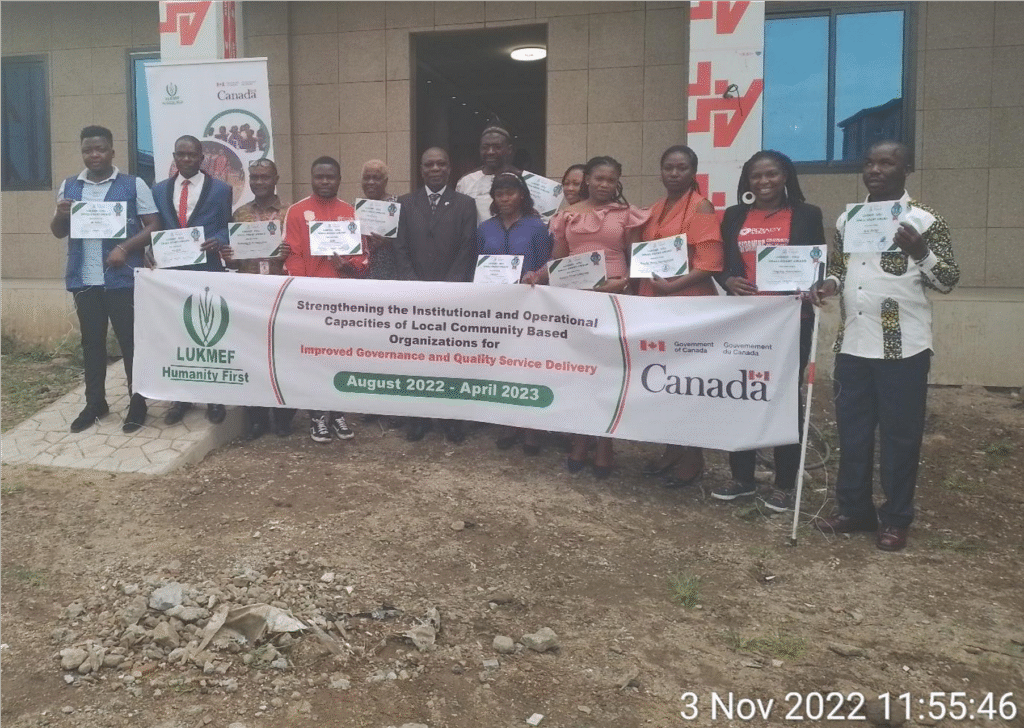
The project successfully strengthened the operational and institutional capacities of twelve Civil Society Organisations (CSOs) across the North West and South West regions of Cameroon. Each CSO received a small grant through the Canadian Fund for Local Initiatives (CFLI) to implement targeted community interventions aligned with human development goals. Prior to the grant awards, LUKMEF conducted a two-day training workshop that equipped participants with vital skills in project management, financial accountability, and donor compliance. The ceremony, held at LACSODEC Hall in Buea, marked a tangible step in empowering local actors to respond to community needs despite ongoing conflict. Participating organisations, including women- and disability-focused groups, were guided on effective documentation, reporting, and impact storytelling. The project deepened collaboration between LUKMEF, local CSOs, and the Canadian High Commission, demonstrating the power of partnership-driven capacity building in fostering local ownership and resilience amidst crisis conditions.
Despite the project’s success, several challenges emerged during implementation. Many CSOs initially struggled to align their proposals with the thematic and financial guidelines of the call, reflecting limited familiarity with donor standards. Some budgets exceeded the stipulated limits, requiring revisions before final approval. The ongoing crisis in the NWSW regions posed logistical and security barriers, affecting communication and coordination among participants. In addition, varying institutional capacities among the beneficiary organisations created disparities in implementation readiness. Limited resources constrained follow-up mentoring and field support, which could have further strengthened project outcomes. Documentation and reporting remain weak areas for many CSOs, with inconsistent systems for data collection and storage. Moreover, the absence of long-term funding limits the sustainability of the newly gained capacities. These challenges underscore the need for continuous technical support and greater investment in institutional strengthening beyond single-cycle interventions.
The initiative highlighted that meaningful development in crisis-affected areas is most effective when rooted in local capacity. Building CSO competencies in compliance, budgeting, and reporting creates trust with donors and enhances sustainability. It also revealed that clear communication of funding guidelines and continuous mentorship are essential to bridge knowledge gaps among grassroots organisations. The emphasis on storytelling and documentation encouraged CSOs to measure and showcase impact, increasing their visibility and credibility. Another critical lesson was that inclusivity strengthens project outcomes—organisations focusing on women, youth, and persons with disabilities contributed to more holistic community engagement. Furthermore, combining financial support with technical guidance produced stronger accountability and improved service delivery. Overall, the project reinforced that when local organisations are empowered and resourced, they become more effective agents of change and better equipped to drive peace, recovery, and development from within their communities.
To consolidate gains and maximize impact, future interventions should prioritize continuous mentorship for CSOs on project design, monitoring, and compliance. Establishing a long-term capacity-building framework through LUKMEF’s LACSODEC would ensure that grassroots organisations receive ongoing technical guidance and peer learning opportunities. Funders should consider flexible grant mechanisms tailored to the unique challenges of crisis-affected regions, enabling adaptive management and innovation. Enhanced coordination among CSOs should be promoted through regular networking and joint learning platforms. Moreover, sustained investment in documentation, data management, and storytelling will amplify local voices and attract further donor engagement. Encouraging inclusive programming that integrates women, youth, and persons with disabilities should remain a priority. Finally, scaling up this model across other conflict-affected areas will extend its positive ripple effects, empowering more organisations to become catalysts for peace, resilience, and sustainable community transformation.

Success Stories

Breaking Barriers: Martha’s Journey with COMAGEND
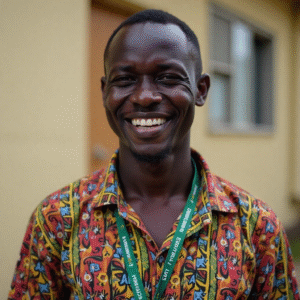
When the crisis erupted in the North West Region, Martha, a 32-year-old teacher from Bamenda, found her voice silenced—not just by the gunfire, but by despair. She had been an active volunteer with the Common Action for Gender Development (COMAGEND), but limited funding and organizational gaps made her advocacy for women’s rights nearly impossible. That changed when COMAGEND was selected under the LUKMEF–CFLI Civil Society Strengthening Project. Through training on proposal writing, documentation, and donor compliance, Martha learned how to structure impactful community projects and report them professionally. COMAGEND also received a small grant to support women-led livelihood initiatives. Armed with new skills, Martha spearheaded a community savings program for internally displaced women in Bamenda. Within months, 45 women had regained income through small businesses. “Before, we were only surviving. Now, we are rebuilding,” she said with renewed confidence. Beyond financial independence, COMAGEND’s project helped restore dignity to women once silenced by conflict. Martha’s story symbolizes the transformative power of equipping women-led CSOs with knowledge and resources. From uncertainty to empowerment, she now trains others on proposal design and leads a network of women advocates amplifying voices for peace and inclusion in the NWSW region.

Seeing Beyond Sight: Emmanuel and MACAFOBIP’s Impact
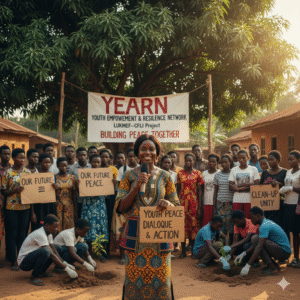
In Manyu Division, Emmanuel, a 28-year-old man living with visual impairment, grew up feeling invisible in community development conversations. The ongoing crisis only deepened that isolation, as humanitarian interventions often overlooked persons with disabilities. The Manyu Circle Association for the Blind (MACAFOBIP) became Emmanuel’s turning point. With support from the LUKMEF–CFLI Project, the organization gained both technical capacity and small grant funding to promote inclusion for the visually impaired. Emmanuel participated in MACAFOBIP’s advocacy training on disability rights and accessibility. Armed with a cane and confidence, he began leading community awareness sessions in Mamfe, challenging stereotypes about blindness. “People used to pity us. Now they see us as partners in development,” he said proudly. The project also helped MACAFOBIP establish a small mobility training center for the blind, serving 30 beneficiaries. For Emmanuel, it was more than training—it was recognition. The LUKMEF-supported project transformed him from a forgotten voice into a disability inclusion advocate. His story embodies resilience and reaffirms that when capacity meets opportunity, no one is left behind, not even in times of crisis.

 A New Generation of Peacebuilders: Linda and YEARN

At 24, Linda, a university graduate from Buea, had lost hope. The conflict in the South West had disrupted her education, scattered her peers, and left her questioning her future. Then she found Youth Empowerment and Resilience Network (YEARN), one of the CSOs supported by the LUKMEF–CFLI Project. YEARN received capacity-building training and a small grant to mentor young leaders in crisis-affected communities. Linda joined their youth peace clubs, learning about dialogue, project management, and advocacy. Soon, she was helping organize youth forums that promoted peaceful coexistence among displaced young people in Buea and Kumba. The project didn’t just teach skills—it built confidence. “Before YEARN, I was just angry and afraid. Now I’m a peacebuilder,” Linda shared. Her efforts led to youth-led clean-up campaigns and peer mentorship programs reaching over 200 young people. Through the LUKMEF–CFLI initiative, Linda transformed from a victim of conflict into a messenger of hope. Her story is proof that investing in youth resilience is investing in peace itself.

Dignity in Labour: Joseph’s Transformation through HUFAC

Joseph, a 40-year-old father from Kumba, worked as a street cleaner. For years, he faced stigma—people saw his work as menial, unworthy of respect. But through the Humanity First Association of Cleaners (HUFAC), supported by the LUKMEF–CFLI Project, Joseph’s story changed. HUFAC benefited from training in organizational management and received a small grant to improve sanitation initiatives. Joseph joined the project, helping organize community cleaning campaigns and hygiene education sessions for local schools. Within months, he was no longer “just a cleaner” but a community leader promoting public health. “Now people call us ‘health ambassadors,’” Joseph said with pride. HUFAC’s improved structure allowed it to attract partnerships from local councils and mobilize volunteers even beyond Kumba. For Joseph, the project restored dignity in labour and strengthened civic pride. His journey shows how capacity development can turn ordinary citizens into extraordinary changemakers who make communities cleaner, safer, and prouder.

From Isolation to Connection — Building a National CSO Network

When the crisis deepened in the North West and South West regions, many community-based organizations became isolated—cut off by insecurity and poor communication. But through LUKMEF’s continuous coaching and creation of digital networking platforms, this isolation began to fade. One of the most transformative stories is that of Beatrice, who led a grassroots women’s cooperative in the remote town of Ndu. Before the project, Beatrice’s group worked alone, struggling to access training or funding. When she joined LUKMEF’s online CSO network through WhatsApp and the LACSODEC platform, she suddenly found herself connected to over 1,000 peers nationwide. Through these exchanges, she learned new fundraising approaches, collaborated on joint proposals, and gained mentorship from experienced CSO leaders. Her cooperative soon became part of a regional women’s network advocating for peace and livelihood restoration. Beatrice’s story reflects the broader impact of digital inclusion and networking—transforming isolation into collective strength. “We may live in crisis zones,” she says, “but through this network, we know we are not alone.” Would you like me to format these five stories into a publication-style layout (with titles, quotes, and images placeholders) for inclusion in a report or newsletter?